
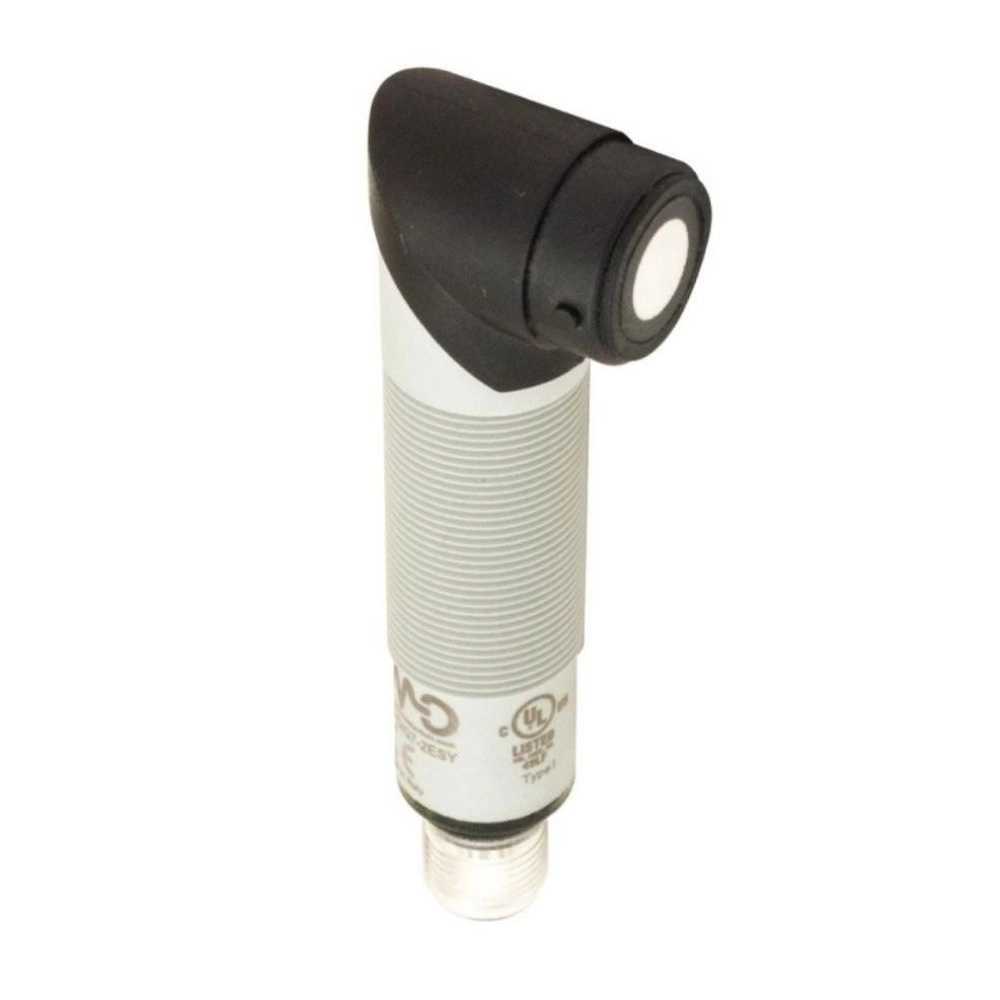
• Sensitory / calibration adjustment: has the Teach-in button to set the parameters
• Repeat accuracy: about 0.50 %
• Beam Angle: approximately 10 ° 2 °
• Resolution: ≤ 3 mm
• Blind Zone Minimum Distance: ~ 50 mm
• Linearity error (Linearity Error): ~ 1 %
• Switch Frequency Frequency: About 10 HZ
• Nutrition voltage: 10… 30 v DC
• Consumable current: ≤ 50 map>
• Protection:
• Protects against short circuit
• Protect against Reverse pole
• Protect against transient voltage (overvoltage)
• Body Material: Plastic (PBT)
• Degree Protection: IP67
• Working temperature: Usually between -20 and +70 degrees Celsius
• Connections: M12 connector or cable with appropriate connection
Work Principles
Ultrasonic sensors do as follows:
1. The transducer sends the high frequency (above human hearing) sensor.
2. These waves are reflected after collision (which may be solid or fluid).
3. The sensor considers the time-off-fly time and calculate the distance between the sensor and the target.
4. Then it converts this gap to an analog or digital signal (in this model 1-2 ma).
5. The sensor for switching applications can also have digital output (NO/NC) and its functionality is adjustable (eg with Teach-in)
Applications
Depending on its specifications and abilities, the UK1A/G7-2ESY sensor can be used in the following:
• Determine the distance or position of the parts on production lines
• Diagnosis of objects or deviations in quality control
• Diagnosis of materials or objects in tanks or chambers
• Position monitoring and control in industrial machinery
• Use in packaging machines that need to detect objects
• Processes that include transparent objects (film, glass, etc.)
• General Applications of Industrial Automation